
Vaccination: Mechanism, History, Principles, Risks, and Prevention — A Homoeopathic Perspective
In contemporary discourse, vaccination is often presented as the sole solution for the prevention of disease. Yet it is important to pause and examine what vaccination truly represents. From a homoeopathic perspective, vaccination may be regarded as either an imperfect application of homoeopathy or as a practice more closely aligned with the principle of isopathy. Homoeopathy, founded on the law of similia similibus curentur (“like cures like”), requires a remedy to be prescribed on the basis of symptom similarity, tailored to the individual’s dynamic state. Vaccination, however, does not follow this individualized approach. Instead, it introduces a disease product or attenuated pathogen into the body with the aim of stimulating immunity. This method resembles isopathy, where the very substance causing disease is used in a modified form to prevent or treat it. The distinction is crucial: Homoeopathy emphasizes individualized prescription, dynamic resonance, and symptom similarity. Isopathy relies on the direct use of disease products or their derivatives, without the nuanced matching of symptoms. Thus, vaccination may be seen as a crude or partial reflection of homoeopathic principles, lacking the refinement of individualized remedy selection. While it seeks to protect populations, it does so by imposing a uniform solution, whereas homoeopathy insists upon the uniqueness of each patient’s constitution and symptom totality.
Admin User
Vaccination a history:
There are two fundamental principles in medical science that determine how any substance can act as a medicine. One is Homoeopathic, and the other is Allopathic.
1. Homoeopathy works on the principle of Similia Similibus Curentur — “like cures like.”
2. Allopathy works on the principle of Contraria Contrariis Curentur — “opposites cure opposites.”
Both principles trace back to Hippocrates, the father of medicine. The homoeopathic principle was later adopted and systematized by Dr. Samuel Hahnemann, while the allopathic principle was promoted and advanced by Dr. Galen. vaccination either works on Homoeopathic or Isopathic principles.
What is Isopathy:
The principles of Isopathy were first formulated by Johann Josef Wilhelm Lux (1773–1849), a veterinary physician from Leipzig, and later developed by Dr. Constantin Hering (1800–1880). Lux introduced the idea of curing a disease using the very products of that same disease, expressed in the maxim Æqualia Æqualibus Curentur (“the same cures the same”).
This makes it clear that the practice of vaccination is not strictly Allopathic in origin but rather shares conceptual ground with Isopathy.
In homoeopathic practice, several remedies are prepared and prescribed on the principles of Isopathy. Examples include:
1. Tuberculinum (derived from tubercular material)
2. Vaccinum (from vaccine lymph)
3. Diphtherinum (from diphtheritic exudate)
4. Psorinum (from psoriatic material)
5. Medorrhinum (from gonorrhoeal discharge)
However, it must be emphasized that using these medicines merely by disease name is not Homoeopathy. For instance: Prescribing Diphtherinum simply because the patient has diphtheria,Or Tuberculinum for tuberculosis,Or Medorrhinum for gonorrhoea,Or Psorinum for psoriasis. such prescription does not align with the homoeopathic principle of Similia Similibus Curentur. True homoeopathy requires a prescription based on the totality of symptoms and the dynamic similarity between patient and remedy, not on the crude identity of disease names.
Discovery of vaccine:
Homoeopathic perspective:
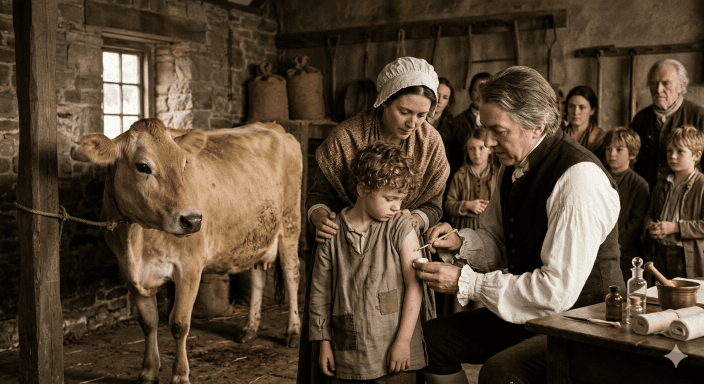
If we think deeply about Dr. Jenner’s experiment, we uncover an important fact: Dr. Jenner used a similar substance, not the same one. Cowpox and smallpox are related diseases, but they are not identical. In this respect, Jenner’s smallpox vaccine was based on the principle of similarity—cowpox providing protection against smallpox—rather than identity.
This is very different from many present‑day vaccines. Modern vaccines, such as those for tuberculosis, hepatitis, and even COVID‑19, are generally prepared from the same pathogen or its components (weakened, killed, or genetically engineered forms). For example:
The BCG vaccine for tuberculosis is made from a weakened strain of Mycobacterium bovis (closely related to M. tuberculosis).
Hepatitis vaccines are produced from viral proteins or inactivated virus.
COVID‑19 vaccines are made using viral RNA, proteins, or inactivated virus—not blood serum from infected patients.
Thus, modern vaccines operate on the principle of isopathy (using the same disease substance to confer protection), whereas Jenner’s original vaccine worked on the principle of similarity (cowpox protecting against smallpox). this makes a measure difference between Jenner vaccine and vaccine of present Era.
Working principal (Morden and homoeopathic point of view) Theory of complex disease.
Risk and prevention:
Vaccination is often associated with the induction of the sycotic miasm within the human organism. In addition, vaccines are prepared with heavy preservatives, some of which have been linked to serious health concerns, including cancer and autism in children. To date, no vaccine manufacturer has made an absolute claim that a particular vaccine provides complete protection against a specific disease. Even in recent times, no company has asserted that the COVID-19 vaccine offers 100% protection against the coronavirus.
In practical observation, despite widespread vaccination programs, the persistence of disease remains evident. For example, the BCG vaccine has been administered in our country for over 40 years, yet active cases of pulmonary tuberculosis continue to exist. The same reality applies to pertussis, measles, and chickenpox, where vaccination has not eradicated the occurrence of these diseases in daily life.
About Admin User
HomeoEra: A Global Platform for Doctors Our mission is to build the largest database of homoeopathic knowledge for future generations. With a special focus on teaching Materia Medica and the Organon of Medicine, we aim to strengthen the foundation of classical homoeopathy worldwide. We invite you to share your cured cases on this platform, contribute to collective learning, and support fellow practitioners. Together, let us take a decisive step toward establishing world-class homoeopathy. Join hands with HomeoEra—where knowledge meets cure.
Comments (0)
No comments yet. Be the first to share your thoughts!