Group 17 Elements and Thyroid Disorders: Physiological, Pathological, and Therapeutic Perspectives

Halogens and Thyroid Disorders: Beyond Iodine Deficiency Iodine deficiency is widely recognized as the leading cause of thyroid disorders, including hypothyroidism and hyperthyroidism . However, deeper research into the...

H

Habib khan

Specialization in Chronic disease

April 12, 20265 min read245 views
Group 17 Elements and Thyroid Disorders: Physiological, Pathological, and Therapeutic Perspectives

Halogens and Thyroid Disorders: Beyond Iodine Deficiency

Iodine deficiency is widely recognized as the leading cause of thyroid disorders, including hypothyroidism and hyperthyroidism. However, deeper research into the therapeutic role of minerals in thyroid health reveals a broader perspective. It is not only iodine but the entire group of halogens (Group 17 of the Periodic Table)—fluorine (F), chlorine (Cl), bromine (Br), iodine (I), and astatine (At)—that influences thyroid function and pathology.

From a homeopathic standpoint, these halogens are significant both in the causation of thyroid disorders and in their curative potential. The connection lies not merely in iodine deficiency but in the common orbital energy shared by all halogens. Each of these elements possesses the same valence shell configuration:

  • General configuration: ns² np⁵

  • Valence electrons: 7 (two in the s-orbital, five in the p-orbital)

Electronic Configurations: of group 17 elements. 

  • Fluorine (Z = 9): 1s² 2s² 2p⁵

  • Chlorine (Z = 17):  3s² 3p⁵

  • Bromine (Z = 35):  3d¹⁰ 4s² 4p⁵

  • Iodine (Z = 53):  4d¹⁰ 5s² 5p⁵

  • Astatine (Z = 85): 4f¹⁴ 5d¹⁰ 6s² 6p⁵

This ns² np⁵ configuration gives halogens their characteristic reactivity and a shared energetic quality. Such orbital energy is responsible for their influence on thyroid physiology, both in disease manifestation and in therapeutic response.

Importantly, the curative aspect depends on the individual symptomatic expression of each element. While iodine is central to thyroid hormone synthesis, other halogens can interfere with or mimic its role, and in homeopathy, they are recognized for their distinct symptomatic pictures. Thus, not only iodine but all halogens in this group hold potential for addressing thyroid disorders when identified through their unique symptomatology.


Fluorine (F=9) and its compound with therapeutic utility

1. Fluoric acid: Indicated for Hyperthyroidism with the characteristic symptomatology of heat flushes, patient may show restlessness, hurriedness and intolerance for heat. more destructive process, more Fluoric acid is an indicated remedy. Useful when thyroid pathology presents with rapid tissue breakdown, varicose veins, or premature aging.

2. Calcarea fluor: mostly suitable for Hypothyroidism. Stony hardness of the Thyroid gland. sluggish metabolism and connective tissue rigidity. Supports conditions where thyroid pathology leads to fibrous growths, nodules, or indurations. Calcarea Fluorica is chosen when thyroid disorder presents with hardness, rigidity, and nodular growths, especially in hypothyroid or goitrous conditions.


Chlorine (Cl=17) and its compound with therapeutic utility

1. Kali muriaticum 
2. Natrum muriaticum 
3. Ferrum muriaticum 
4. Aurum muriaticum 
5. Plumbum muriaticum
6. Chlorinum 
7. Acid muriaticum 

Bromine (Br=35) and its compound with therapeutic utility:
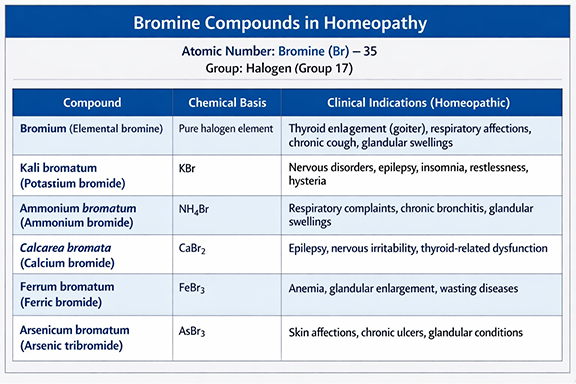
1. Bromine 
2. Kali Bromatum
3. Ammonium bromatum
4. Calcarea bromata
5. Ferrum Bromatum
6. Arsenicum Bromide 

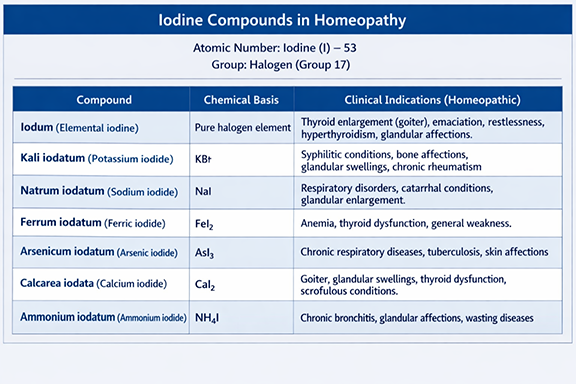
Iodine (I=53) and its compound with therapeutic utility:
Astatine and Its Potential in Homeopathy:

Astatine (symbol At, atomic number 85) is a highly radioactive halogen element belonging to Group 17 of the periodic table. Due to its extreme rarity and instability, no homeopathic medicine has ever been prepared from Astatine or its compounds. Unlike its halogen counterparts—Chlorine, Bromine, and Iodine—which are well established in homeopathic materia medica, Astatine remains absent from clinical practice.
The primary reasons for this exclusion are:
1. Radioactivity: All isotopes of Astatine are unstable, making them unsafe for preparation and administration in traditional homeopathic methods.
2. Scarcity: Astatine occurs only in trace amounts in nature and is usually produced artificially in nuclear research facilities.
3. Lack of Tradition: Homeopathy has historically drawn upon naturally available substances, and Astatine’s rarity has prevented its inclusion.

Hypothetical Future Potential:

If, in the future, scientific advances allow the safe preparation of a homeopathic remedy from Astatine, its pharmacological profile suggests possible relevance in conditions such as:
1. Cancerous goiter: Given Astatine’s affinity for thyroid tissue in nuclear medicine research, a homeopathic preparation might hypothetically address malignant thyroid enlargement
2. Thyrotoxicosis: Its halogen nature and thyroid-targeting properties could make it a candidate for regulating hyperthyroid states.

Conclusion

At present, Astatine has no role in homeopathy due to its radioactivity and scarcity. However, if future innovations make it possible to harness this element safely, it could potentially open new therapeutic avenues—particularly in thyroid-related pathologies such as cancerous goiter and thyrotoxicosis. This remains a speculative but academically intriguing prospect for the evolution of homeopathic Materia medica.

Medicines belongs to the Animal and Vegetables kingdoms: 

These medicines retain their therapeutic relevance in thyroid disorders because they embody the essential halogen elements within their protoplasmic constitution, particularly as derived from marine habitats. The marine origin of these substances ensures a natural affinity with thyroid physiology, given the gland’s dependence on halogen balance—most notably iodine, but also the broader spectrum of halogens. Thus, their curative potential lies in harmonizing thyroid function through the elemental resonance of halogens embedded in living protoplasm 
1. Sepia 
2. Spongia 
H

About Habib khan

B.H.M.S

Dr. Habib khan practising Homoeopathy in Gwalior last from 25 years. He is a single remedy Practicnor.

Have a Question?
Ask Habib khan about "Group 17 Elements and Thyroid Disorders: Physiological, Pathological, and Therapeutic Perspectives" and get a personalized response directly to your email.

0/500 characters

0 characters (minimum 10 required)

🔒 Privacy Notice: Your information will only be used to respond to your query and won't be shared with third parties.

Comments (0)

Sign in to join the discussion

Sign In

No comments yet. Be the first to share your thoughts!