
From Phosphorus to Bismuth: Comparative Utility of Group 16 Elements in Gastritis Management.
In homeopathy, disease is understood as a disturbance of the vital force. This disturbance is not material but energetic, and therefore can only be corrected by another dynamic influence—what Hahnemann termed the medicinal force. Thus, both disease and cure operate on the same energetic plane. A noteworthy observation is that elements belonging to the same group in the periodic table often display similar therapeutic effects. This similarity extends beyond chemistry into the dynamic sphere of homeopathy. For instance, the Group 17 elements (Fluorine, Chlorine, Bromine, Iodine), known as halogens, act directly on the thyroid gland and are frequently indicated in thyroid disorders. In parallel, the Group 15 elements (Nitrogen, Phosphorus, Arsenic, Antimony, Bismuth) exert a marked influence on the stomach, particularly in conditions such as gastritis. Thus, the periodic table serves not only as a chemical classification but also as a therapeutic guide, helping physicians select remedies whose energetic affinities resonate with specific organs and pathological states. This reflects a deeper harmony between nature’s design and healing
Habib khan
Deals with Chronic diseases
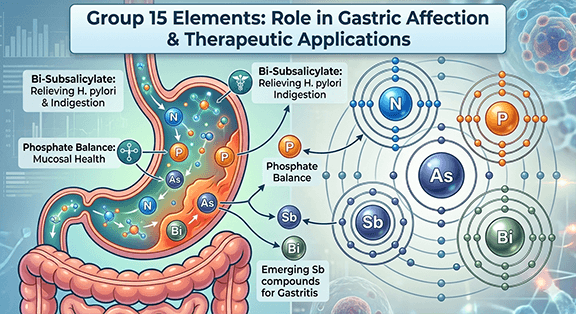
Utility of group 15 Elements in gastric affection
In homeopathy, disease is seen as a disturbance of the vital force. This disturbance is not physical but energetic, so it can only be corrected by another energetic influence, which Hahnemann called the medicinal force. In this way, both disease and cure work on the same level of energy.
An interesting fact is that elements in the same group of the periodic table often show similar healing effects. This similarity is not just chemical but also applies in homeopathy.
For example, the Group 17 elements (Fluorine, Chlorine, Bromine, Iodine), known as the halogens, act directly on the thyroid gland and are often used in thyroid problems. In the same way, the Group 15 elements (Nitrogen, Phosphorus, Arsenic, Antimony, Bismuth) affect the stomach and are linked with conditions like gastritis.
So, the periodic table is not only a chemical chart but also a guide for therapy. It helps doctors choose remedies whose energetic effects match certain organs and diseases. This shows a deep connection between chemistry and homeopathy, reflecting nature’s design in healing.
All elements of Group 15 have a strong effect on stomach disorders, especially gastritis. While studying these elements, the following points are important to note.
1. Although all elements show similarity in their pathological effects, each differs in its initiating features. Therefore, they must be carefully distinguished.
2. Radioactivity increases with the size of atomic number, and with the increase of atomic number severity of disease also increases, hence bismuth is more suitable for severe gastritis in the comparison of Phosphorus.
3. Because of similar orbital energy, all medicines share certain common features. However, that is not our main focus; instead, we must pay close attention to their distinguishing characteristics.
Group 15 elements as a Homoeopathic medicine
I once treated a case of gastritis caused by burns, where the patient presented with identical symptoms: she longed for cold water but vomited it after some time. when it became warm in the stomach. Phosphorus provided her instant relief—not only from the vomiting but also from the intense burning sensation.
About Habib khan
B.H.M.S
Dr. Habib khan practising Homoeopathy in Gwalior last from 25 years. He is a single remedy Practicnor. trusted by Thousand. Clinic address: 203 cosmo business, park, new city centre Gwalior,
Comments (0)
No comments yet. Be the first to share your thoughts!