
Belladonna (Deadly Nightshade)
Belladonna, commonly known as Deadly Nightshade (Atropa belladonna), is a perennial herb belonging to the Solanaceae family. Renowned for its striking purple flowers and glossy black berries, the plant has long captivated both healers and historians. Its name, meaning “beautiful lady” in Italian, reflects its historical use in cosmetics, where extracts were applied to dilate pupils for an alluring appearance. Medicinally, belladonna contains potent tropane alkaloids—atropine, scopolamine, and hyoscyamine—that exert anticholinergic effects. These compounds have been employed to relieve muscle spasms, reduce secretions, and manage certain inflammatory conditions, though their therapeutic window is narrow and toxicity risk is high. While modern pharmacology recognizes belladonna derivatives in controlled medical use, the plant itself remains a symbol of the fine line between remedy and poison, embodying the dual nature of nature’s pharmacopeia.
Admin User
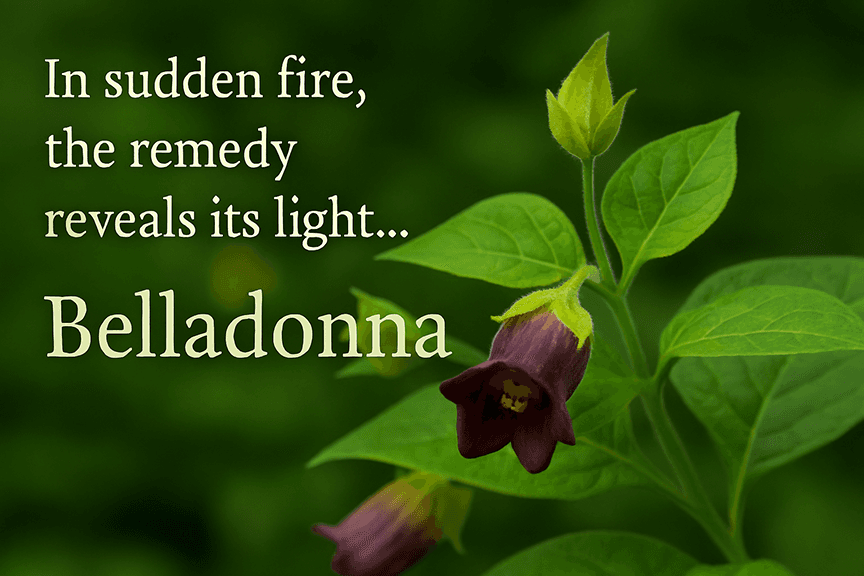
Belladonna
(Deadly Nightshade)
An introduction:
Atropa belladonna is a homeopathic medicine belonging to the vegetable
kingdom and is a member of the Solanaceae family. In its crude form, it is a
highly poisonous plant; however, in potentized form it serves as a remarkable
remedy. The plant contains three principal alkaloids: atropine, scopolamine
(hyoscine), and hyoscyamine. Belladonna is native to Europe and Western Asia.
It was Dr. Samuel Hahnemann himself who first proved Belladonna, marking a
significant milestone in the history of homeopathic proving. The medicine is
prepared from the leaves, roots, and fruits of the plant.
Constitutional feature
Medicine is particularly suitable for plethoric, sensitive,
excitable individuals; children prone to febrile and inflammatory conditions
Sphere of action
1. Nervous System
- Acts powerfully on the cerebrospinal
system.
- Produces congestion, irritation, and
inflammation of the brain and meninges.
- Symptoms: delirium, restlessness,
spasms, convulsions, hypersensitivity to light, noise, and touch.
- Sudden onset of acute neurological
states.
2. Circulatory System
- Causes active congestion and
inflammation with heat, redness, and throbbing.
- Sudden, violent fevers with flushed
face, dilated pupils, and bounding pulse.
- Marked tendency to vascular
excitement and hyperemia.
3. Skin and Mucous Membranes
- Produces redness, heat, swelling,
and dryness.
- Eruptions resembling scarlet fever
(smooth, bright red rash).
- Dry, burning skin with high
temperature.
4. Respiratory System
- Acute inflammation of throat,
tonsils, and larynx.
- Sudden onset of sore throat,
tonsillitis, pharyngitis with burning pain and difficulty swallowing.
- Dry, spasmodic cough, worse at night.
5. Digestive System
- Acts on the gastrointestinal tract
with dryness of mouth and throat.
- Difficulty swallowing liquids,
spasmodic constriction.
- Abdominal pain with colic and
distension.
6. Special Senses
- Eyes: dilated pupils, photophobia,
congestion, throbbing headaches.
- Ears: acute otitis, throbbing
earache, hypersensitivity to sound.
- Nose: congestion, dryness, sudden
coryza.
7. General Characteristics
- Sudden, violent, and intense symptoms.
- Right-sided affinity
(many complaints begin or are worse on the right side).
- Modalities: worse from touch, noise,
light, draught of air; better by rest in a dark, quiet room.
Therapeutic utility:
It is important to note that although typhoid fever also presents with intense heat, Belladonna should never be used in typhoid cases. This is because typhoid fever does not develop suddenly; its onset is gradual, unlike the abrupt and violent nature of Belladonna fevers.
3. Neuralgia: All type of nerve pain with burning and heat, pain gets worse by motion, light, and cold. patients want to coverup painful parts if remain open pain gets worse. (Kali-carb) Belladonna is a patient of nervous hyperesthesia.
4. Gall stone colic: In gallstone colic, the patient often presents with hot, flushed skin. The pain is aggravated by the slightest motion or jar. When the physician approaches, the patient pleads: “Doctor, please don’t touch my bed—it hurts me.” This is a clear expression of aggravation from motion, reminiscent of Bryonia. Of course, many remedies share this modality, but the location and sphere of action differ.
Belladonna acts profoundly on circular muscle fibers—such as those of the ductus communis choledochus, urethra, and ureter. It produces spasms of these fibers, effectively holding the stone in place. A single dose of Belladonna relaxes the spasm, allowing the stone to escape naturally.
5. Headache: Belladonna is a medicine of congestive headache like Opium, but the characteristic features of both the medicines are different. Belladonna patient is excitable patient. more the congestion more the excitability. Opium has opposite condition, more the congestion patient becomes more insensible. rest of the features are the same as we assume, violent sudden attack with red face, and hot burning skin. worse by motion and light, stretching head backward is amelioration.
5. Sciatic pain: All complaints of Belladonna are aggravated by motion and jarring. The descending pain from the hip in Belladonna presents a unique modality: it worsens during rest and is relieved by motion. Therefore, the patient continues walking in order to alleviate the pain. this is an antagonist symptom from the general nature of medicine. this pain is caused by exposure to cold air, on the head after hair cutting.
6. Headache: Belladonna produce congestive headache. a famous keynote is Aconite produce turmoil in the heart and Belladonna produce turmoil in the head. However, both medicines are very similar in action. patient wants to stretch her head backward; it gives relief in headache. bending forward in sitting or in standing position aggravate headache symptoms. Headache caused by exposure to cold air, aggravate by touch and ameliorated by gentle pressure.
7. Strabismus: An acute, suddenly developed strabismus associated with cerebral congestion. Even after the congestion is relieved, the strabismus persists in a remittent form, with the eyes tending to rotate inward.
8. Sore throat: spasmodic sore throat, spasm produced by trying to swallow liquid especially. throat very sensitive to touch. mouth is dry, patient thirsty, want to drink water frequently but in little quantity just like Arsenic Album. thirst for lemon water that produce relief in the complaints. most of the fever in belladonna attaints with thirst for lemon water.
9. Haemorrhoid: very painful and burning haemorrhoid, patient want to lie with legs apart. constitutional feature of belladonna always must be present, heat in the head with red face, patient has frequent desire for passing stool but can pass less.
10. Cystitis: catarrhal condition of the urinary bladder. constant desire for urination. can pass urine drop by drop, severe burning in urethra urinating while. cramping pain in urinary bladder even after passing urine, constant urging. occasionally patient passes bloody urine, with small blood clots. incontinence of urine during brain disorder.
11.Uterine haemorrhage: Belladonna is particularly suitable for female complaints when compared to male. This does not mean that Belladonna has no role in male conditions; rather, its symptomatology aligns more perfectly with female troubles. Belladonna is indicated in cases of uterine haemorrhage, presenting with the same phenomena: uterine congestion, hypesthesia of the uterus, and aggravation from motion or jar. The expulsive flow of blood is characteristically warm. Belladonna is also a medicine of Prolapsus of the Uterus and Dysmenorrhoea.
12. Pleurisy: Belladonna is a remedy often indicated in right-sided pleurisy. Bryonia also covers right-sided pleurisy, yet the two represent opposite expressions of the condition—two different sides of the same coin. To clarify: in right-sided pleurisy, the Bryonia patient seeks relief by lying on the affected (right) side, finding comfort in the pressure. In contrast, the Belladonna patient cannot tolerate any pressure on the inflamed area and avoids lying on the affected side altogether
Hemangioma: Belladonna 1M has been cured a case of Hemangioma, Patient was a two-year-old child, have a large Hemangioma on the back in line of spinal cord, her mother consulted me. I gave her a dose of Belladonna - 1M single dose and instruct her to give her child in the morning empty stomach, after two months, she again visited on my clinic. and told me, "Doctor the tumor is no more. Belladonna cured Her's child Hemangioma.
About Admin User
HomeoEra: A Global Platform for Doctors Our mission is to build the largest database of homoeopathic knowledge for future generations. With a special focus on teaching Materia Medica and the Organon of Medicine, we aim to strengthen the foundation of classical homoeopathy worldwide. We invite you to share your cured cases on this platform, contribute to collective learning, and support fellow practitioners. Together, let us take a decisive step toward establishing world-class homoeopathy. Join hands with HomeoEra—where knowledge meets cure.
Comments (1)
This is the Unique way of reading materia medica, really it's amazing.