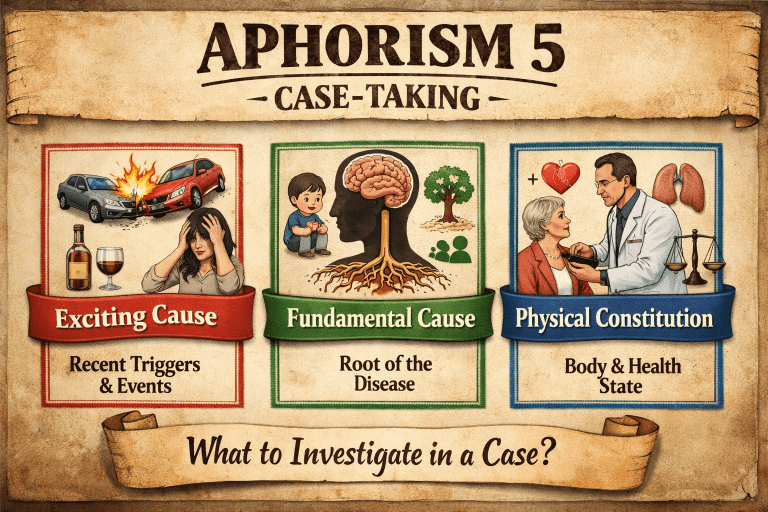
Aphorism - 5, "The Investigation of Causes: A Guide to Case Taking in Acute and Chronic Diseases"

In Aphorism 5, Hahnemann emphasizes that the physician must carefully investigate not only the present symptoms but also the possible exciting and maintaining causes of disease. He points out that in many cases, especially chronic ones, external factors such as lifestyle, habits, occupations, and environmental influences may perpetuate illness. He writes: “Useful to the physician in assisting him to cure are the particulars of the most probable exciting cause of the acute disease, as also the ascertainable occasion of the chronic malady.” Thus, Aphorism 5 serves as a guiding principle for case taking, reminding practitioners to look beyond the immediate symptom picture and to consider the broader causal context—whether acute triggers or chronic maintaining factors. actually, teaching on the case taking starting from aphorism 5.

A

Admin User

May 20, 20265 min read508 views
Aphorism - 5, "The Investigation of Causes: A Guide to Case Taking in Acute and Chronic Diseases"
Aphorism - 5

Aphorism - 5, 

" Useful to the physician in assisting him to cure are the particulars of the most probable exciting causes, of the acute disease, as also the most significant points in the whole history of the chronic diseases, to enable him to discover its Fundamental cause, which is generally due to a chronic miasm. In these investigations, the ascertainable physical constitution of the patient (especially when the disease is chronic), his moral and intellectual character, his occupation, mode of living and habits, his social and domestic relations, his age, sexual function, etc., are to be taken into consideration." 

Or 
(In the simplest way) 

Aphorism 5 is directly concerned with the different criteria for case‑taking in both acute and chronic diseases. In this Aphorism, Dr. Hahnemann advises that, in acute diseases, the investigation of exciting causes must be taken into consideration, whereas in chronic diseases, the investigation of fundamental causes is particularly essential. In order to investigate both the fundamental and exciting causes, the entire history of the chronic disease must be recorded so that the physician may understand the miasmatic phenomena underlying the presented malady. Especially during the case‑recording of chronic diseases, along with the active miasm at work, the physical constitution of the patient, his moral and intellectual character, occupation, mode of living, habits, social and domestic relations, age, and sexual function are also to be taken into consideration.          

Word meaning and explanation: 

Exciting Cause: All factors that have the capacity to aggravate a disease condition are termed exciting causes. Most aggravating modalities are included under this category, and in acute diseases, the majority of our prescriptions are based upon them. for instance, Headache worse by exposure to sun heat, Asthma get worse after eating rice. etc. 

Maintaining causes: Maintaining causes are slightly different from exciting causes, maintaining cause are those responsible for maintaining disease condition. these are wrong habits or wrong diet. for example, his cough is not getting relief because he has the tendency to drinks water cold. here habit of drinking cold water is maintaining cause. 

Acute & Chronic Disease: In Homoeopathy, the distinction between acute and chronic disease is defined differently than in conventional medicine. It is not determined by the duration of illness, but by the presence or absence of a miasm. All diseases that do not originate from a miasm are termed acute diseases, whereas all diseases of miasmatic origin are classified as chronic diseases.

Miasm: Refer to the article on miasm.

Fundamental causes: Miasms are the fundamental causes, these are three in number, Psora, Syphilis, and Sycosis. 

Story form (Explanation) 

Acute disease: In this Aphorism Dr. Hahnemann clearly pointed out that what should be our criteria for investigation in Acute and Chronic diseases. it is useful for the physician to assist the cure, try to find out, which are the probable factor that are responsible for disease aggravation that are termed as exciting causes it may be environmental, food related, seasonal or emotional. exciting causes are better known as the aggravating modality of the diseases. 

Chronic disease: Case-taking criteria for chronic disease are some different. apart from exciting cause here we need to investigate many more thing. broader spectrum criteria are given by Dr. Hahnemann to assist cure particularly for Chronic diseases, that are. 

Fundamental cause: it is Miasm should be consider the prime and fundamental cause of all chronic diseases. Psora is the parent of all chronic illness, most ancient, most troublesome miasm. (Refer to the article Sphere of the action of Psora) apart from Psora following point also to be consider assisting cure in Chronic disease. 

Physical Constitution: The first man created by God was free from every deviation of evil—without deformity or malformation. Yet in the present age, features such as a disproportionately large head, imperfect dental arch, narrow chest, or over-flexed limbs are all recognized as miasmatic imprints. Thus, the determination of physical constitution is inseparable from the recognition of miasm. A prescription based on physical constitution is, in essence, a miasmatic prescription.

At present, not a single human body is entirely free from miasm. Psora exists latently within every human economy, forming the most fundamental substratum of disease.


Moral & intellectual character: Miasm does not confine its influence on the physical constitution alone; it extends its reach into the realm of the mind. Evil thoughts, emotional disturbances, abnormal desires, and weakened memory—all such mental symptoms must be taken into careful consideration when investigating chronic disease.

When disease establishes its seat in the mind, mental symptoms demand special attention, for they often reveal the deeper imprint of the miasmatic disturbance and guide the physician toward a more accurate prescription.


In the investigation of chronic disease, attention must extend beyond the physical and mental constitution to include the patient’s habits, mode of living, sexual function, and the environment in which he or she resides. These factors often conceal the maintaining causes that perpetuate illness.

Thus, a thorough case analysis requires not only recognition of the miasmatic foundation but also careful evaluation of lifestyle and surroundings, for within these domains the hidden sustaining causes of chronic disease may lie.


A

About Admin User

HomeoEra: A Global Platform for Doctors Our mission is to build the largest database of homoeopathic knowledge for future generations. With a special focus on teaching Materia Medica and the Organon of Medicine, we aim to strengthen the foundation of classical homoeopathy worldwide. We invite you to share your cured cases on this platform, contribute to collective learning, and support fellow practitioners. Together, let us take a decisive step toward establishing world-class homoeopathy. Join hands with HomeoEra—where knowledge meets cure.

Have a Question?
Ask Admin User about "Aphorism - 5, "The Investigation of Causes: A Guide to Case Taking in Acute and Chronic Diseases" " and get a personalized response directly to your email.

0/500 characters

0 characters (minimum 10 required)

🔒 Privacy Notice: Your information will only be used to respond to your query and won't be shared with third parties.

Comments (0)

Sign in or sign up to join the discussion

No comments yet. Be the first to share your thoughts!

Aphorism - 5, "The Investigation of Causes: A Guide to Ca... | HomeoEra Journal