
Aphorism - 2, “Hahnemann’s Vision about the highest ideal of cure” (avoidance for unwanted medicinal aggravation)
In Aphorism 2 of the Organon of Medicine, Hahnemann sets forth his vision of the physician’s mission: the highest ideal of cure. He insists that true healing must be rapid, gentle, and permanent, restoring health in its entirety without inflicting new suffering. This principle is not merely technical but profoundly ethical. To cure is not enough—the manner of cure must respect the patient’s dignity and avoid unnecessary aggravation. Hahnemann’s emphasis on gentleness was revolutionary in his time, when harsh purgatives, bloodletting, and massive doses often worsened disease. By contrast, he envisioned a medicine that works with precision, using the smallest dose necessary to stimulate recovery. In this way, the physician becomes not a tormentor but a restorer, guiding nature toward balance without violence. Thus, Aphorism 2 is more than a clinical directive; it is a moral compass. It reminds us that the physician’s art is measured not only by the disappearance of symptoms but by the absence of harm in the process of healing. The highest ideal of cure is a union of efficacy and compassion—a cure that is swift, certain, and enduring, yet free from unwanted medicinal aggravation.
Admin User
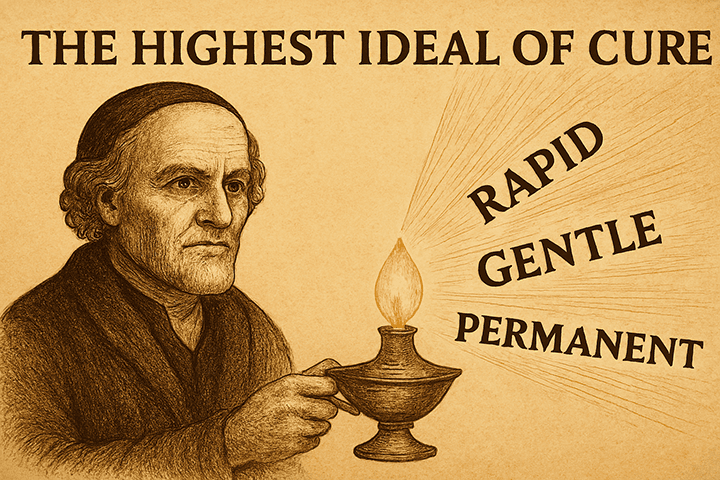
Aphorism - 2
“The highest ideal of cure is rapid, gentle and permanent
restoration of the health, or removal and annihilation of the disease in its
whole extent, in the shortest, most reliable and most harmless way, on easily
comprehensive principles”
Or
(In the simplest way)
"Cure should be rapid,
gentle, and lasting. The disease must be removed in its entirety, within the
shortest possible time, in a reliable manner, and without causing harm to the
patient—guided always by principles that are clear and easy to understand."
Word Meaning and Explanation
Story form of the Aphorism -2
Long ago, in a quiet study lit by candlelight, Dr. Samuel Hahnemann sat reflecting on the mission of the physician. He had already declared in Aphorism 1 that the physician’s duty is to cure. But now, he asked himself: What kind of cure should it be?
He imagined a suffering patient—a man worn down by illness, longing for relief. The physician approaches, not with harsh instruments or painful remedies, but with wisdom and compassion.
“The cure,” Hahnemann thought, “must be three things: rapid, gentle, and permanent.”
- Rapid: The patient should not wait endlessly for relief. Just as a thirsty traveler long for water immediately, so too must the cure act swiftly. Hahnemann rejected the notion that homeopathy is slow. To him, a true cure must come with speed.
- Gentle: The physician must heal without adding suffering. Hahnemann envisioned a treatment that soothed rather than tormented. He did not accept prolonged aggravations or the appearance of new diseases as part of healing. If such things occurred, it was not gentleness—it was error in prescribing.
About Admin User
HomeoEra: A Global Platform for Doctors Our mission is to build the largest database of homoeopathic knowledge for future generations. With a special focus on teaching Materia Medica and the Organon of Medicine, we aim to strengthen the foundation of classical homoeopathy worldwide. We invite you to share your cured cases on this platform, contribute to collective learning, and support fellow practitioners. Together, let us take a decisive step toward establishing world-class homoeopathy. Join hands with HomeoEra—where knowledge meets cure.
Comments (0)
No comments yet. Be the first to share your thoughts!