
Aphorism - 1, “Hahnemann’s Vision of the True Physician” (True meaning of the “Sick”)
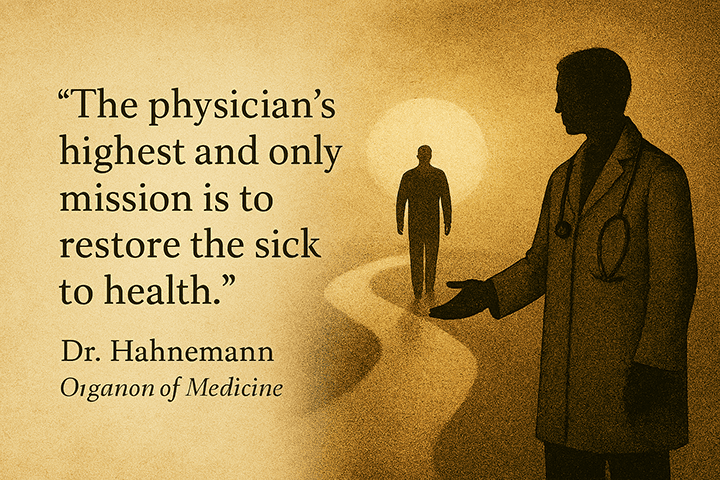
The physician’s high and only mission is to restore the sick to health, to cure as it is termed." This timeless declaration by Dr. Samuel Hahnemann underscores the noble purpose of medicine. The physician is entrusted not with the pursuit of fame, profit, or theoretical speculation, but with the singular duty of healing the suffering humanity. True cure, as Hahnemann envisioned, is not merely the suppression of symptoms but the complete restoration of harmony and vitality. This principle reminds us that medicine must remain patient-centered, guided by compassion and a commitment to genuine healing.
Admin User
Aphorism - 1
“The physician’s high and only mission is to restore the sick to health, to cure, as it is termed. “
Or
(in
the simplest way)
“As
a noble doctor, your foremost duty is to help patients regain their health, in
accordance with the guidance given in the Organon of Medicine.”
Word meaning and Explanation.
Physician – is
the person, who involve in the art of healing, do the following work.
a.
Diagnose the disease - (perceives
the turmoil present in the vital force, that is different in every individual
case)
b.
Prevention – if
doctor or the physician aware about the causes, responsible for illness of the
patient or sick individual, so he or she has the liability to prevent them.
c.
Education – it
is also the duty of physician to educate the society and patient, about the
factor and causes, caused illness.
d. Compassionate Care: Offering empathy,
reassurance, and moral support
e. Treatment – and finally offer treatment to
their patient according to law of “Similia” true fundamental law
of therapeutics.
High and only – here
the word high and only use for specific sense. Dr. Hahnemann want
to direct our attention toward our sole mission that is to “help our patient
regaining their health or restore the sick” in Dr. Hahnemann word. Not to
consume your energy in earning bread and butter and forming hypothetical
concept or empty speculation that is too called theoretic medicine.
Mission – Dr.
Hahnemann addressed to their follower, (Physician), if you are true healer, so
healing the sick individual is not your duty, not your profession but your
mission. It should be not your purpose to gain name and fame or forming the
empty speculation but your mission is to restore the sick.
Restore – when
we try to split this word Re-store, it has a hidden meaning. Re – means =
again, Store – means = to collect. If we interpret this word, it reveals that
“there is something in the human economy that is well arranged, well patterned
in the healthy condition of organism. But during disease conditions now it is
de-arranged and mal-patterned. It is the duty of sick healer re-arrange and
re-pattern that, and that is nothing but a vital force. “The derangement
of the vital force is the true cause of the disease. “
Health – is
the state of the living organism. In which spiritual, autocratic, dynamic,
intelligent vital force that animate our material body, rules without any
restriction, retains all the body parts of the organism in admirable,
harmonious vital operation, as regard both sensation and function. In this
respect abnormal sensation is the first step on which we can detect disease in this
vital-device.
Cure – it
is not the suppression of the symptoms, not the dynamic movement of disease
(Production of sequalae) but simply re-arrangement of the de-arranged vital
force. Re-gaining health and harmony is the true sign of cure.
As it is termed – as were
told by Dr. Hahnemann in the book, (Organon of medicine) it is to be better,
for you to understand thoroughly this quotation read complete Organon of
medicine consistently.
Sick: This word is used by Dr. Hahnemann in the Organon of Medicine, Aphorism 1, but he did not explain it further. It was Dr. J.T. Kent who first attempted to explain this term according to his own understanding. According to Kent, Hahnemann used the word in the sense of the internal man, distinct from the material body. This internal man is constituted of body, mind, and spirit, and expresses itself through will, emotion, and intelligence.
This interpretation is quite different from the theory given by Hahnemann and later promoted by Dr. Boenninghausen—the theory of complete symptoms. Boenninghausen emphasized paying precise attention to every affected location, its specific sensation, the relevant modality, and any concomitant symptoms if present. This stands in contrast to Kent’s view, where “sick” refers to the internal man as a whole. Hence, Kent emphasized symptoms belonging to the patient in their totality for the selection of medicine, while Boenninghausen insisted on considering each location with its specific sensation, modality, and concomitant separately.
From the above discussion, it is clear that Boenninghausen’s theory of complete symptoms and Kent’s theory of general symptoms represent two distinct schools of Homoeopathy. Dr. Kent formulated a new school of thought, apart from the Hahnemannian system of treatment, and this divergence arose primarily from his misinterpretation of the word “sick.”
The actual meaning of “sick” remains a question. According to my understanding, Hahnemann used this word to describe the organism deprived of energy. In a healthy condition, the organism’s energy flows evenly and smoothly, creating harmony and allowing life to be enjoyed and directed toward higher purposes of existence. In disease, however, this harmony is disturbed, and the organism experiences dis-ease (disease).
Thus, simply put: “Sick” means an organism with a deranged vital force. This derangement may be general or local, and the sole mission of Physician is to restore balance.
Story form of Aphorism – 1.
Story: Hahnemann’s Vision of
the True Physician
Long ago, in the quiet study
of Dr. Samuel Hahnemann, a group of young physicians gathered. They had come
not for fame or fortune, but to hear the words of a man who had redefined the
art of healing.
Hahnemann looked at them
with gentle seriousness and spoke:
"The physician’s high and only mission is to restore the sick to
health—to cure, as it is termed."
The room fell silent. The
students leaned forward, sensing that these words carried more than
instruction; they carried a philosophy of life.
He explained that a physician
was not merely someone who prescribed medicines. A true physician was a healer
who must first diagnose the unique disturbance in each patient’s vital
force. Then, with wisdom, they must work to prevent illness, guiding
society away from harmful causes. They must also educate, teaching
patients how disease arises, and offer compassionate care, giving
comfort and moral strength. Finally, they must treat, applying the law
of Similia—the principle that like cures like.
But Hahnemann warned them:
“Do not waste your energy chasing bread and butter, or weaving empty theories.
Your mission is not speculation, nor fame. It is healing.”
One student asked, “Master,
what does it mean to restore?”
Hahnemann smiled. “To
restore is to re-store—to bring back what was once whole. In health, the human
organism is beautifully patterned, harmonious. Disease is nothing but the
derangement of the vital force. Your task is to re-arrange, to re-pattern, to bring
back harmony.”
He described health
as a state where the vital force rules freely, keeping every sensation and
function in balance. The first sign of disease, he said, was abnormal
sensation—a whisper from the vital force that something was wrong.
And cure, he
continued, was not suppression of symptoms, nor the masking of disease. Cure
was the gentle re-ordering of the vital force, the regaining of harmony.
Finally, Hahnemann urged
them: “If you wish to understand this truth fully, read the Organon of
Medicine. Read it not once, but consistently, until its spirit lives within
you.”
The students left that day
with more than knowledge. They carried a mission. They understood that to be a
physician was not a profession, but a calling—a sacred duty to restore the sick
to health.
About Admin User
HomeoEra: A Global Platform for Doctors Our mission is to build the largest database of homoeopathic knowledge for future generations. With a special focus on teaching Materia Medica and the Organon of Medicine, we aim to strengthen the foundation of classical homoeopathy worldwide. We invite you to share your cured cases on this platform, contribute to collective learning, and support fellow practitioners. Together, let us take a decisive step toward establishing world-class homoeopathy. Join hands with HomeoEra—where knowledge meets cure.
Comments (1)
Now Aphorism is easy to understand